What Is Web3 and Technology Why Does It Matter?
If you’ve spent any time online in the last few years, you’ve probably heard the term “Web3” tossed around — often alongside buzzwords like blockchain, crypto, and NFTs. But beyond the hype, what does Web3 actually mean, and why should you care? Let’s break it down in plain language.
A Quick Trip Through Web History
To understand Web3, it helps to know what came before it.
Web1 (roughly 1990s–early 2000s) was the “read-only” web. Websites were static pages that users could view but rarely interact with. Think early Yahoo or personal homepages — information flowed one way, from creator to reader.
Web2 (mid-2000s–today) is the web most of us grew up with. It’s interactive and social — think Facebook, YouTube, Instagram, and Google. Users don’t just consume content; they create it, comment on it, and share it. The catch is that a handful of large companies control the platforms, the data, and the rules. Your posts, photos, and personal information live on servers you don’t own, governed by terms of service you didn’t write.
Web3 is the next proposed evolution — a version of the internet built on decentralized technology, primarily blockchains, where users have more direct ownership and control over their data, identity, and digital assets, without relying on a central company to manage everything.
The Core Idea Behind Web3
At its heart, Web3 is about shifting power away from centralized intermediaries and back toward individual users. Instead of a company like Meta or Google storing and monetizing your data, Web3 applications use blockchain technology to let users interact directly with each other and with digital services.
A few concepts are central to how this works:
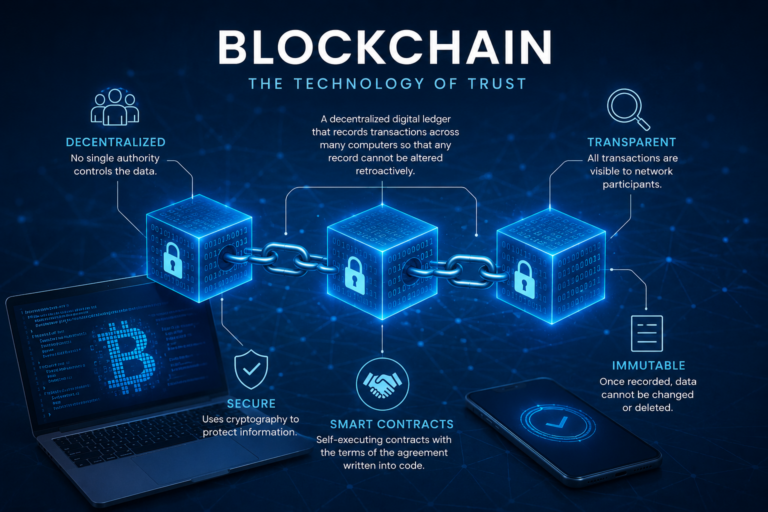
- Blockchain: A distributed, tamper-resistant ledger that records transactions across a network of computers rather than a single central server. No single entity controls it.
- Decentralization: Instead of one company owning the infrastructure, control is spread across many participants, reducing the risk of a single point of failure or control.
- Digital ownership: Through tools like cryptocurrency wallets and non-fungible tokens (NFTs), users can hold verifiable, transferable ownership of digital assets — money, art, in-game items, or even pieces of a company.
- Smart contracts: Self-executing pieces of code that automatically carry out agreements when certain conditions are met, without needing a middleman like a bank or a lawyer to enforce them.
Why People Are Excited About It
Proponents of Web3 point to several potential benefits:
Ownership and control. In Web2, if a platform bans your account or shuts down, you lose access to everything tied to it. In Web3, assets like cryptocurrency or NFTs are stored in a wallet you control, not on a company’s servers.
Reduced reliance on middlemen. Financial transactions, for instance, can happen directly between two parties using smart contracts, potentially cutting out banks, payment processors, or other intermediaries — and their fees.
Transparency. Because blockchain transactions are recorded on a public ledger, activity can be independently verified rather than taken on faith from a single company.
New economic models. Web3 has enabled things like decentralized finance (DeFi), where people can lend, borrow, and trade without a traditional bank, and creator economies where artists and builders can be paid more directly by their audiences.
The Skepticism Is Real Too
Web3 isn’t without serious criticism, and it’s worth being clear-eyed about it.
Many blockchain networks have historically consumed large amounts of energy, though newer systems have made progress on efficiency. The space has also seen its share of scams, speculative bubbles, and volatile markets — the collapse of major crypto exchanges and NFT projects has cost everyday users real money. Critics also argue that true decentralization is harder to achieve in practice than in theory, since a small number of large token holders or companies often end up wielding outsized influence anyway. And for most non-technical users, Web3 tools remain clunky and confusing compared to the polished apps we’re used to.
Why It Matters, Regardless of Where You Land
Even if you’re skeptical of the crypto hype cycle, the underlying questions Web3 raises are important ones: Who should control our data? Should individuals have more direct ownership over their digital lives? Can technology reduce the power concentrated in a few large platforms?
Whether or not “Web3” as a specific technology ends up reshaping the internet the way its advocates hope, the conversation it has sparked — about privacy, ownership, and decentralization — is likely to influence how the next generation of digital products gets built.
The Bottom Line
Web3 represents an ambitious attempt to rebuild the internet around user ownership and decentralized infrastructure rather than centralized corporate control. It brings real potential benefits — more control over your data and assets, fewer middlemen, and greater transparency — but also real risks and unresolved challenges. Understanding the basic ideas behind it, rather than just the hype or the skepticism, is the best way to figure out where you stand.